A Parking Attendant Costs $40,000 a Year. A Parking Automation System Costs $1,120.

Updated: Aug 9
There is a booth at the entrance of a sixty-space car park somewhere near you. Inside it, someone is sitting on a stool with a cash tin, a roll of paper tickets, and a barrier remote taped to the window frame. They have been there since seven in the morning. At six in the evening they will go home, and the barrier will stay up, or stay down, and either way the car park stops earning.

That booth is the most expensive object on the property.
Not the barrier. Not the surfacing. The booth, because of who has to sit in it. One person covering one shift, with employer contributions and cover for holidays and sickness, lands somewhere north of $40,000 a year in most European and North American markets. Two shifts doubles it. And the booth caps your revenue at the hours a human is willing to be there.
This is the arithmetic that makes parking automation less of a technology decision and more of a survival one.
What a parking automation system actually is
Strip away the vendor language and a parking automation system does four things:
Identifies who is arriving — by licence plate, QR code, phone, or reservation record.
Admits or refuses them by physically operating a barrier, bollard, gate, or lock.
Charges them, either at exit or automatically against a stored card.
Accounts for all of it, so you know what happened without counting cash.
Anything that does all four without a person in a booth is a parking automation system. Anything that does only some of them is a component, and components are where most operators lose money — a licence plate camera with no payment layer, a booking app with no way to actually open the gate, a barrier with no record of who came through.
The failure mode is almost always the same. The digital layer and the physical layer never meet. A driver books a space online, arrives, and finds the barrier down and nobody to lift it. That is not an automated car park. That is a website attached to a car park.
The two ways to buy one, and why the expensive way is usually wrong
Option one: rip and replace. Remove the existing barrier, install a new integrated system from a single manufacturer, complete with its own controller, its own payment terminal, its own software, and its own service contract. Quotes for a two-lane site typically start around $15,000 and climb from there. Lead time runs six to twelve weeks. The car park closes for part of the installation.
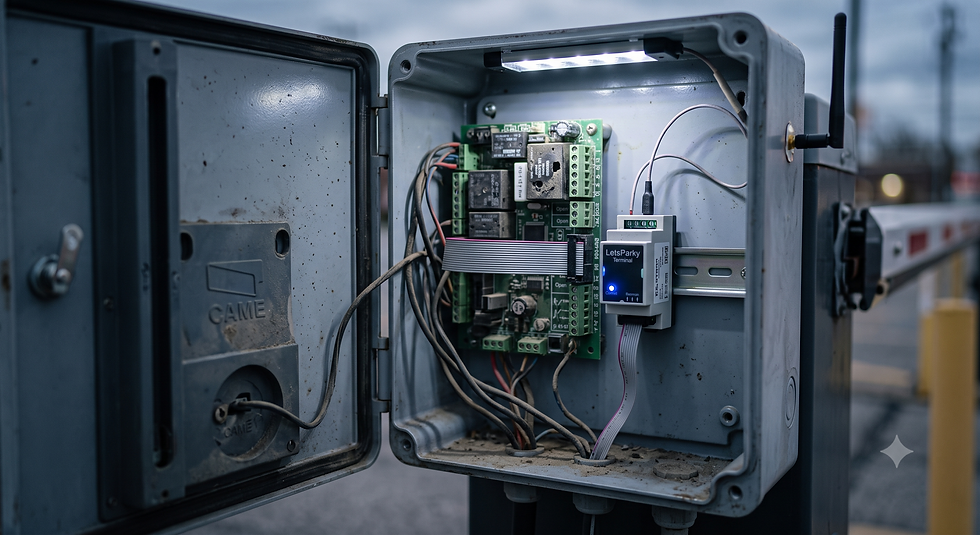
Option two: retrofit. Leave the barrier where it is. Add a small gateway device that speaks to the barrier's existing control board through the same dry-contact relay the remote already uses, and connect that device to the internet. The barrier does not know or care that the signal is now coming from a reservation instead of a plastic fob.
Most barriers installed in the last twenty years — Came, Nice, FAAC, BFT, Magnetic, Automatic Systems, and the long tail of regional manufacturers — already expose exactly the terminals you need. They were built to accept a signal from a loop detector or an intercom. A retrofit gateway is just one more thing pressing the same button.
A LetsParky Terminal does this job for about $200 per lane and installs in roughly ten minutes. It mounts within thirty metres of the barrier, connects over WiFi, and turns the barrier into something a reservation system can open.
The cost comparison, honestly laid out
Staffed booth | Rip-and-replace system | Retrofit automation | |
Up-front cost | $0 | $15,000 – $30,000 | ~$200 per lane, plus optional plate camera |
Annual running cost | $40,000+ per shift | $1,500 – $4,000 service contract | ~$36 – $120 per device |
Install time | Immediate | 6 – 12 weeks | Same day |
Operating hours | Whatever you staff | 24/7 | 24/7 |
Works with existing barrier | Yes | No | Yes |
Revenue when nobody is there | None | Full | Full |
The number that should stop you is the last row. A staffed car park earns nothing outside staffed hours. Every evening, every Sunday, every public holiday, the asset sits there depreciating and generating zero. An automated car park does not distinguish between Tuesday at eleven in the morning and Saturday at two in the morning, and neither do the drivers who need it.
The payback math, using real numbers
Take a modest assumption. Three paid uses per day, at an average of $5 each. That is $15 a day in gross transactions from a single space.
On the LetsParky model, the platform takes 20% of collected revenue, so $12 a day reaches the operator. A Bouncer smart lock listed at $320, or a Terminal at around $200, pays for itself in under a month of ordinary use.
Scale that to a sixty-space site running at even 40% paid utilisation and the arithmetic stops being interesting and starts being uncomfortable — because it means the booth has been costing you the difference every year it has been open.

What you lose in the twelve months you spend thinking about it
This is the part vendors skip, so here it is plainly.
You lose the off-hours entirely. If your car park is staffed twelve hours a day, you are monetising half the calendar. Twelve unstaffed hours a day across sixty spaces is roughly 260,000 space-hours a year that produce nothing.
You lose the drivers who could not find you. A car park that cannot accept a reservation does not appear when a driver plans a trip. INRIX found that 63% of US drivers had avoided driving to a destination specifically because of parking. Those drivers did not complain to you. They just went somewhere else.
You lose the data. A cash tin produces no occupancy curve, no peak analysis, no evidence for a pricing change. You cannot optimise a number you have never measured, and every month without measurement is a month of pricing decisions made on instinct.
You lose your position in the map layer. Google Maps has begun surfacing parking reservations directly inside navigation results, and Uber's acquisition of SpotHero pulled parking inventory into the mobility ecosystem proper. Inventory that cannot be booked cannot be listed. Inventory that cannot be listed is invisible to the exact moment when a driver decides where to park.
Where to start if you have one site
Start with one lane and one device. Retrofit the entrance barrier, connect it, and run it for thirty days alongside whatever you do now. You will have an occupancy curve, a payment record, and an honest answer about your own utilisation inside a month, for the cost of a tank of fuel.
Then decide about the booth.
Frequently asked questions
What is a parking automation system? A parking automation system is the combination of hardware and software that identifies arriving drivers, opens a barrier or lock for authorised ones, collects payment, and records every transaction, without an attendant present. Modern systems can be retrofitted onto existing barriers rather than replacing them.
How much does it cost to automate a car park? A full rip-and-replace installation typically costs $15,000 to $30,000 for a two-lane site. A retrofit approach, which adds a gateway device to the barrier you already own, costs roughly $200 per lane plus a monthly software fee starting around $3 per device. First-year total cost for a retrofitted single-lane site is approximately $1,120 including an optional plate recognition camera.
Can I automate a barrier I already own? In almost all cases, yes. Barriers manufactured in the last two decades accept an external open signal through a dry-contact relay — the same input the handheld remote uses. A gateway device wired to that input can trigger the barrier from a reservation, an app, or a licence plate match.
Does an automated car park still need staff? Not for routine operation. Most operators retain a remote support number and periodic cleaning or inspection visits. The recurring cost of a shift attendant, which is the largest single line item in a small car park's operating budget, is removed.
How long does installation take? A retrofit gateway installs in about ten minutes per barrier. Plate recognition cameras and payment terminals add a few hours. A full rip-and-replace system typically takes six to twelve weeks from order to commissioning.
Next step: If you already have a barrier, you are most of the way there. Read Your Barrier Already Works. It Just Can't Take a Booking. to see exactly what the retrofit involves — or talk to us about your site.

